What to Do When Your Spouse Dies in Missouri
Quick Answer
If your spouse died in Missouri, do not assume everything needs probate. Joint spousal accounts and property often pass to the surviving spouse outside probate, especially when titled as tenants by the entirety or joint owners with survivorship rights. Probate is usually only needed for assets in your spouse's name alone with no beneficiary, TOD/POD designation, trust ownership, or other transfer shortcut.
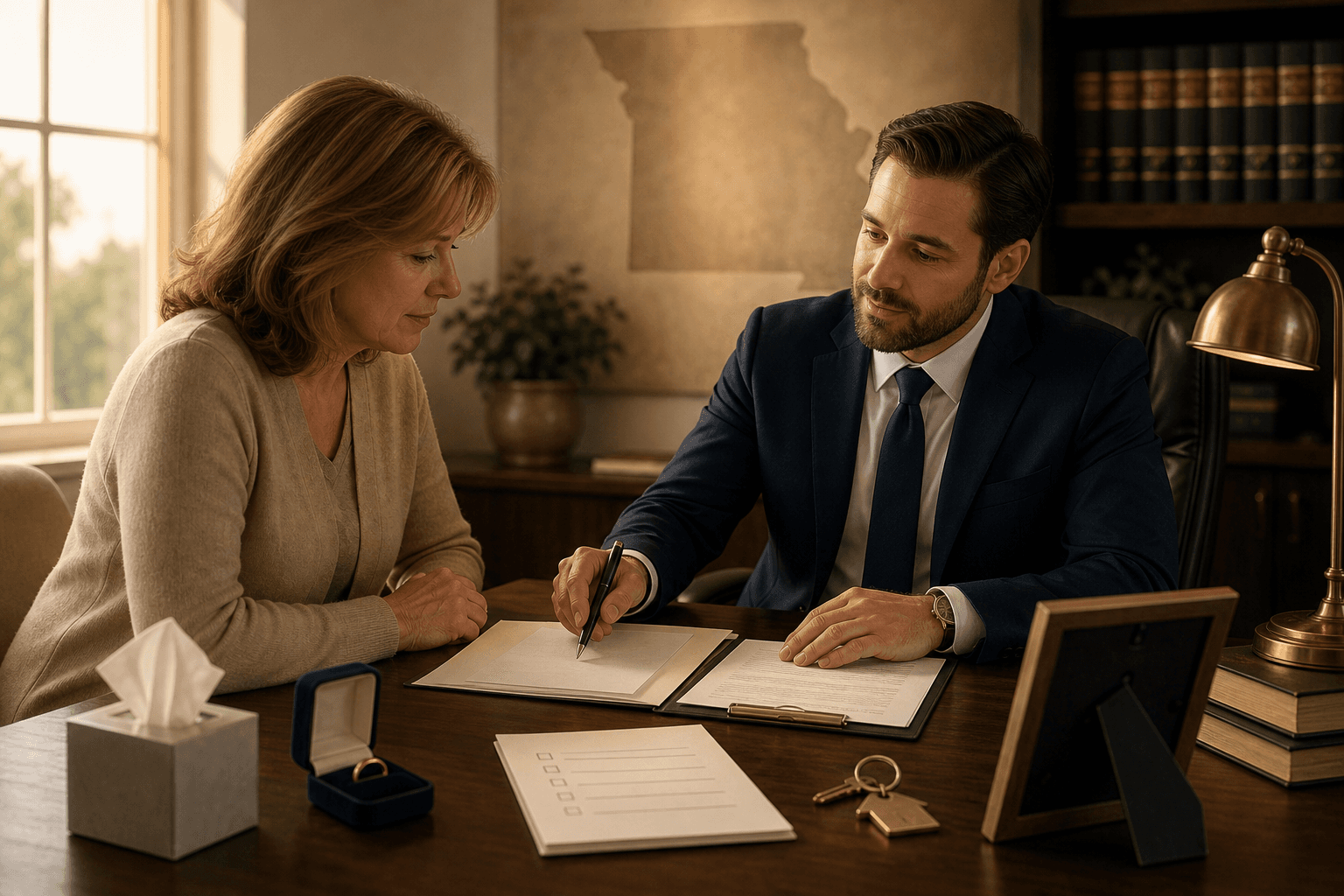
If your spouse just died, the first legal question is not "Do I need probate?"
The better question is: what is actually stuck?
Missouri probate is usually asset-by-asset. A jointly titled house may pass to you without probate. A joint bank account may be yours already. A life insurance policy may go straight to the named beneficiary. But a vehicle, account, or parcel of land titled only in your spouse's name may need some kind of court order or Department of Revenue process before anyone can transfer it.
So start with a list. Not a perfect list. Just a real one.
- House and land
- Bank accounts and CDs
- Vehicles, boats, trailers, and motorcycles
- Retirement accounts and life insurance
- Business interests
- Personal property with meaningful value
- Debts, mortgages, loans, and medical bills
For each item, write down how it is titled, whether there is a beneficiary, and approximate value. That list usually tells you which path fits.
If you want the broader asset-transfer framework first, read our guide on when probate is required in Missouri or use the Missouri probate decision tool. This article is for the surviving spouse who needs to know what to do next.
Step 1: separate probate assets from non-probate assets
A probate asset is property your spouse owned in their name alone with no legal transfer path at death.
Common examples:
- A bank account only in your spouse's name with no POD beneficiary
- A vehicle only in your spouse's name with no TOD beneficiary or surviving joint owner
- Real estate only in your spouse's name with no beneficiary deed or survivorship language
- Personal property that needs formal authority to sell, transfer, or collect
A non-probate asset already has a transfer path. The court usually does not need to appoint a personal representative for that asset.
Common examples:
- Joint accounts with survivorship rights
- Property owned by spouses as tenants by the entirety
- POD or TOD accounts
- Life insurance and retirement accounts with beneficiaries
- Real estate covered by a valid Missouri beneficiary deed
- Trust-owned assets
This is where surviving-spouse cases are different from many other probate cases. In Missouri, many married couples hold the house and bank accounts in a way that automatically protects the surviving spouse. That does not mean probate is never needed. It means the probate question is narrower than people think.
Step 2: check the house and real estate
If you and your spouse owned Missouri real estate together, look at the deed.
Missouri recognizes tenancy by the entirety for married couples. Under RSMo 442.450, real estate granted to multiple people is generally treated as tenancy in common unless the deed says otherwise, but grants to husband and wife are treated differently. In plain English: many deeds to spouses create survivorship-style ownership, often tenancy by the entirety.
If the property was held by you and your spouse as husband and wife, the property may pass to you outside probate. You may still need to record paperwork, such as a death certificate or affidavit, to clean up the land records. But that is different from opening a probate estate.
Probate is more likely if:
- The deed was only in your spouse's name
- Your spouse owned a fractional interest as tenant in common
- The property had no beneficiary deed
- The title history is unclear
- The property needs to be sold and the title company requires court authority
If real estate is the main issue, see our guide on how to transfer a house title after death in Missouri. If the property is in St. Charles County or St. Louis County, our county probate guides can also help you understand the local court process.
Step 3: check bank accounts and financial accounts
For bank accounts, ask the bank how the account was titled. Do not guess from who used the debit card or who paid the bills.
Missouri law gives strong protection to spousal joint accounts. Under RSMo 362.470, deposits in the names of husband and wife are generally considered tenancy by the entirety unless the account documents say otherwise. Joint and survivorship account documents can also be conclusive evidence that the surviving owner takes the account.
That means many surviving spouses can claim joint accounts with a death certificate and bank paperwork, not probate court.
Probate is more likely if the account was:
- Only in your spouse's name
- Missing a payable-on-death beneficiary
- Owned by a business or trust with unclear authority
- Frozen because the bank needs Letters Testamentary, Letters of Administration, a small estate affidavit, or a refusal of letters order
For more detail, read how to claim a deceased loved one's bank account in Missouri.
Step 4: handle the vehicle separately
Vehicles deserve their own check because Missouri has a surviving-spouse shortcut that is easy to miss.
If the vehicle was jointly titled or had a transfer-on-death beneficiary, you may be able to transfer it without probate. If it was only in your spouse's name, a surviving spouse may still be able to claim one vehicle using Missouri Department of Revenue Form 2305, called the Affidavit to Establish Title to Exempt Property.
Form 2305 is tied to Missouri's exempt property statute, RSMo 474.250. That statute gives a surviving spouse, or if there is no surviving spouse then unmarried minor children, certain exempt property rights, including one motor vehicle or pickup truck.
Form 2305 is not a magic form for every car. Read it carefully. The form is generally for one vehicle owned by the deceased spouse being transferred to the surviving spouse or minor children as exempt property. It also asks the surviving spouse to confirm, among other things, that the spouses were married at death and were not divorced or separated for more than one year before death. If there was a nuptial agreement, that may matter.
If Form 2305 fits, it can save a spouse from opening probate just to transfer a car. That is exactly the kind of shortcut families miss when they start with "probate or no probate" instead of looking at each asset.
For the full vehicle breakdown, see how to transfer a car title after death in Missouri.
Step 5: decide whether a spousal refusal of letters fits
Missouri has another shortcut for surviving spouses called a refusal of letters. The statute is RSMo 473.090.
A refusal of letters is not full probate. The court is essentially saying that it will not appoint a full personal representative because the estate is small enough, or the surviving spouse's statutory rights are large enough, that a full estate administration is not necessary.
For a surviving spouse, the key idea is this: if the probate assets do not exceed what the spouse may receive through exempt property and family allowance rights, the court may refuse letters and let the spouse collect the property by court order.
That matters because spouse cases do not always fit neatly into the $40,000 small estate affidavit box. A spousal refusal of letters is based on Missouri's spouse and family allowance statutes, not just the general small estate limit.
In practice, local courts often use practical dollar thresholds. St. Louis County materials, for example, discuss spousal refusal cases around $24,000 unless the spouse provides evidence supporting a larger maintenance allowance. Jackson County's packet asks for additional proof when the estate is over $24,000. Other counties may handle the details differently.
A spousal refusal of letters may help when:
- Your spouse had a bank account only in their name
- There is a vehicle, refund, check, or modest asset that cannot be collected without authority
- The total probate property is small
- The surviving spouse is the person who should receive the property under Missouri's exempt property and family allowance rules
- You want to avoid full probate if the law and local court procedure allow it
It may not fit when:
- The estate has substantial real estate or high-value probate assets
- There are disputes among heirs or beneficiaries
- Your spouse had minor children from another relationship and the local form requires a different process
- A creditor problem or title problem makes full administration safer
- The property is not actually a probate asset because it already passed by joint title, POD/TOD, beneficiary deed, or trust
County practice matters here. Some counties publish refusal of letters packets. Some clerks are more willing to answer process questions than others. Some situations that look simple on paper become messy because of title, heirs, creditor claims, or family conflict.
What documents should a surviving spouse gather?
Before calling the court, a bank, the Department of Revenue, or a lawyer, gather the basics:
- Certified death certificates
- Marriage certificate if requested
- Any will or trust documents
- Deeds for real estate
- Vehicle titles
- Recent bank, brokerage, and retirement statements
- Life insurance beneficiary information
- Funeral bill and proof of payment
- Mortgage, loan, and credit card statements
- A rough list of personal property with meaningful value
- Any prenuptial or postnuptial agreement
For a refusal of letters, local court forms may also ask for an asset exhibit, account statements, vehicle information, real estate descriptions, appraisals or value estimates, and expense information if the spouse is asking for a larger allowance.
This is annoying paperwork. It is also the fastest way to avoid paying for a probate case you do not need.
Should you pay your spouse's bills right away?
Be careful.
A surviving spouse often feels pressure to pay every bill immediately. Some bills should be paid. Some should wait. Some creditors may need to make a claim in probate. Some debts may be secured by property, like a mortgage or car loan, and ignoring them can create a separate problem.
Before using your own money or estate money, sort bills into categories:
- Mortgage, utilities, insurance, and other bills needed to preserve property
- Funeral expenses
- Medical bills
- Credit cards and unsecured debts
- Taxes
- Joint debts that may also be your legal responsibility
If you are unsure, read should I pay my deceased loved one's bills in Missouri? before writing checks. This is one of those areas where a well-intended payment can create avoidable confusion later.
When full probate may still be needed
Full probate may still be the right answer if your spouse owned probate assets worth more than the shortcut procedures can handle, if real estate needs a formal personal representative's deed, if creditors need to be dealt with through the court process, or if family members disagree about who should receive what.
Common full probate triggers include:
- Real estate titled only in the deceased spouse's name
- No beneficiary on a significant account
- Business interests that require court authority
- A lawsuit or claim involving the estate
- Disputes between spouse, children, stepchildren, or other heirs
- Need to sell estate property during administration
If full probate is needed, the surviving spouse may still have important rights. Missouri law provides surviving spouses with potential rights to exempt property, family allowance, homestead allowance, elective share, and intestate share depending on the facts. Those rights can affect what the spouse receives and what creditors or other heirs receive.
Our guide on Missouri probate family allowances explains those protections in more detail.
A simple surviving-spouse decision tree
Use this order:
- Is the asset jointly titled with survivorship rights or tenancy by the entirety? If yes, it probably avoids probate.
- Does the asset have a valid POD, TOD, beneficiary designation, beneficiary deed, or trust owner? If yes, use that transfer process.
- Is the asset a vehicle that may qualify for Missouri DOR Form 2305? If yes, check the DOR requirements before opening probate.
- Are the remaining probate assets small enough for a spousal refusal of letters? If yes, check the county probate forms and local requirements.
- Is the remaining probate estate $40,000 or less? If yes, a small estate affidavit may fit.
- If none of those options work, full probate or another court proceeding may be needed.
The trap is treating all assets the same. They are not the same. The house, the checking account, the car, and the life insurance policy may each have a different answer.
Talk to a Missouri probate attorney before opening the wrong case
If you are a surviving spouse in Missouri, we can help you sort the assets before anyone files the wrong thing.
That usually means answering four questions:
- What passed to you automatically?
- What can be claimed with a form, death certificate, or beneficiary paperwork?
- What might qualify for Form 2305, refusal of letters, or a small estate affidavit?
- What truly needs full probate?
Schnurbusch Law helps families with Missouri probate and small estate issues, including St. Charles County, St. Louis County, and other Missouri counties. If you are not sure what your spouse owned or which procedure fits, start with the probate decision tool or schedule a probate consultation.
The goal is not to open probate. The goal is to transfer the assets correctly with the least court involvement the law allows.
Need a Missouri probate attorney?
If you are handling an estate in St. Louis, St. Charles, or another Missouri county, Schnurbusch Law can help with flat-fee probate administration.
Talk to a Missouri Probate Attorney